Six Different Kinds of Power
When people talk about power at work, they usually mean one thing:
Authority.
It ends up being about your title or whether you get the final say. But that’s just one type of power. And honestly? It’s not the best one (in my opinion).
Power isn’t a single thing you either have or don’t. It's not something you can even control, really. It’s a set of tools, and too many leaders are only relying on one.
The Six Types of Power (Whether You Realize It or Not)
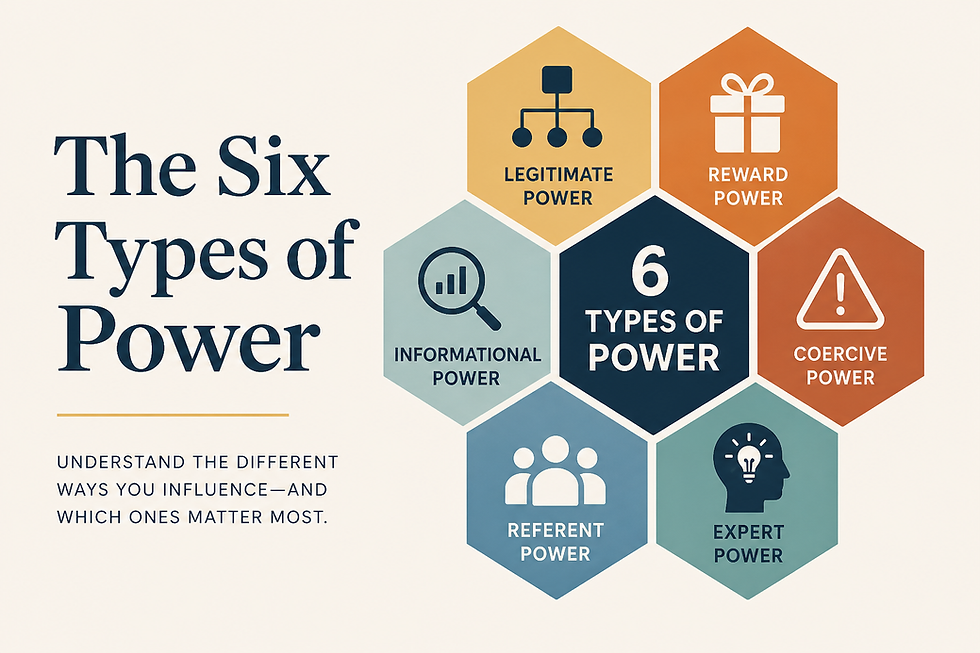
Back in 1959, social psychologists John R. P. French and Bertram Raven mapped out the different ways humans influence each other. Unlike so much that came from white guys in the 50s, their framework still helps us understand power at work today.
They identified six types of power that leaders use all the time. The thing is, we're not always using them intentionally.
Legitimate Power: “Because I'm Your Boss”
This is the power that comes with your role and its place in the hierarchy. It's your title, your right to make decisions. It’s the most visible kind of power, and often the one leaders reach for first because it’s clear and immediate. But it has some pretty major limits. It works because people agree (explicitly or implicitly) to follow the structure, not necessarily because they’re bought in. (Think about when your parents used it with you growing up. It worked, but not because you loved it.)
But the moment trust erodes or pressure rises, legitimate power alone starts to feel thin. It can get things moving, but it rarely builds the kind of commitment that keeps them going. Leaders often rely on legitimate power (because it's so deeply entrenched in so many systems at work), but it's really overrated: it only works as long as other people are willing for it to work.
Reward Power: “I Can Make Your Life Better”
This is your ability to give others something they want. Promotions, raises, cool projects, client-facing opportunities, or that training you need so desperately.
It's effective, but it creates if/then transactions, which author Dan Pink says are less effective for tasks that require cognitive effort and skill. But over time, it can quietly shift the dynamic from purpose to transaction, where effort is tied to what you get rather than ownership. When that happens, people start to calculate instead of commit. Used well, reward power reinforces what matters and celebrates contribution; overused, it turns leadership into a series of exchanges rather than a source of real momentum.
Coercive Power: “I Can Make Your Life Worse”
This is the flip side of reward. It's the do-it-or-else mentality that bullies rely on. It shows up in performance warnings, withheld opportunities, or the threat of loss, and it can produce fast compliance when something urgent or non-negotiable is on the line. But it comes at a cost. Over time, it creates fear, narrows thinking, and trains people to focus on avoiding mistakes rather than doing great work. You might get the behavior you asked for, but not the engagement, creativity, or trust that make that behavior sustainable. It’s a lever that works, but one that wears down the system the more you rely on it.
Expert Power: “They Know What They’re Doing”
When I got my first training job, my boss had a masters in education. She taught me how to teach others and I gobbled up everything I could from her while I worked there. We weren't friends, really, and we saw the world differently, but she knew so much about what I wanted to learn that I followed her a lot longer than I would have anyone else.
Expert power comes from what you know and how well you can apply it to solve problems. People don’t follow because they have to; they follow because they trust you know what you’re doing. It’s one of the most durable forms of power, but it has a subtle trap: the more capable you are, the easier it is to become the answer person instead of teaching others how to answer.
Used well, expert power isn’t about having all the answers. It’s about raising the level of thinking around you so others can find them too.
Referent Power: “They Make Me Feel Good”
This is personal power. It’s about how people feel around you. Referent power is built on relationships and credibility, not authority. It’s why two people with the same title can have completely different levels of influence. (And why people with "lower" titles can have more power than their managers.)
People follow not because they have to or because there’s something in it for them, but because they want to. It shows up in the quiet moments: whether people speak honestly around you, whether they bring you problems early, whether they choose to align with you even when it’s not required. It depends on consistency between what you say and what you do. And done right, it amplifies every other kind of power you have.
Informational Power: “Let Me Show You”
This kind of power is quietly becoming one of the most important. It's the ability to influence through what you know and how you share it. It’s not just access to data, but the skill of providing the right context, at the right time, in a way that helps people see clearly and decide confidently. It shows up when you connect dots others haven’t, simplify complexity, or bring transparency to what feels unclear.
Informational power doesn’t rely on position; it relies on credibility and clarity. And it can come from any title in the team.
You can see the impact of informational power most clearly at organizations where information is hoarded and secrets are kept. In those situations, only those "in the know" have power.
Not all power works the same way. Some types of power create compliance, others create commitment. Legitimate, reward, and coercive power tend to get short-term action and are tied to your position in the organization (generally). Expert, referent, and informational power tend to create lasting influence and are free from organizational constraint.
In other words, you can get people to do something, or you can get them to want to do it.
The odds are that you don’t need more power. The question is, which kind are you using when it matters most?


Comments